|
Scavenger SV-4 & Emergent Horror |
|
|
|
Scavenger SV-4 and Emergent Horror(Why a Laid-Back Space-Sim Rogue-Like Turned Into A Stand-Out Fight For Survival After 13 Hours Of Gameplay)There are not a lot of games that I feel are tailored specifically to my tastes. Some are too gamey, others are too unserious, some not simulationist enough. But, there are rare occasions where I find myself playing a game that I feel is made for me specifically. Scavenger SV-4 isn't just one of those games that I find myself in awe of how well it fits into my gaming niches, it's a microcosm of a design philosophy that I try to exhibit in my own works, in short, the game is FUN, spelled I.R.C. (Interactive, Reactive, Cohesive). I first started examining what made something "Fun" after watching an interview clip with Hideo Kojima shortly after the release of Death Stranding when the interviewer asked Kojima, "Is the game fun?" and he didn't seem to have a response to the question. I initially assumed that Kojima had lost the plot and finally gone mad. How could you not KNOW that your game was fun. Is it not the designers job to create "Fun"? But after playing the game a couple of times I realized that I was hooked to it's gameplay loop, and I too struggled to describe the game in a way that sounded like "Fun".  Maybe it was on one of those long treks up a snow capped mountain in the first Death Stranding game that I began to realize that "Fun" was a construct. It didn't exist. It was like "The Rule of Cool" it was ubiquitous in design but it's ubiquity belayed it true meaning. Activities that we consider "Fun" and engaging have commonalities between them, the underlying building block of fun, the foundations of engagement, that I have identified as being Interactivity, Reactivity, and Cohesion. I'm going too dumb things down for bit to literal baby level. What are some activities you enjoyed as a child that today are mundane to you? The two examples for me are flipping light switches and door stoppers. Light switches are interactive, as all switches are, and reactive in that flipping causes an immediate change, the cohesion comes from the fact that the change is most often in the environment we, as well as the switch, currently inhabit. Flicking door stoppers is a bit more complex, but they are interactive in that you can pull them back, reactive in that when you let them go they will make a very interesting sound, and the cohesion comes from their relative placement in relation to the floor a necessary component for anything to keep the attention of a toddler for very long. When designing a game, or piece of interactive media, we must ask ourselves if the elements we put into play are supporting each other in this same way of interactivity, reactivity, and cohesion. Through this we can create works which exude Ludo-Narrative Harmony and avoid it's maligned antithesis. 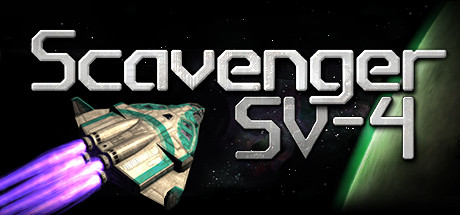 Scavenger SV-4 is a Space-Sim Roguelike with Horror Elements. That is to say it's not a horror game. You don't get scary vibes from anything on your first couple of play throughs. It took me 13 hours before anything really scary happened. But, there in-lies the effectiveness of the horror. It's not a horror waiting in a haunted amusement park, it's horror lurking within the mundane, the accepted, the normal. The only places where true horror lies. Jump scares are most effective where they do not belong, as is any kind of fear. An alligator in a body of water in Florida is a danger but normal, the same alligator somehow between you and your bedroom door is a nightmare. The game sees the player as the captain of a deep space scavenger ship which through one way or another has come to a planet containing signs of alien life as well as high amounts of radiation. So much radiation, in fact, that the player risks early death from cancer if they waste too much time exploring the very finely detailed spaceship or, as I did, playing the game within a game on the ships computer. Luckily since this is the written word we are not constrained by such limitations as time limits. 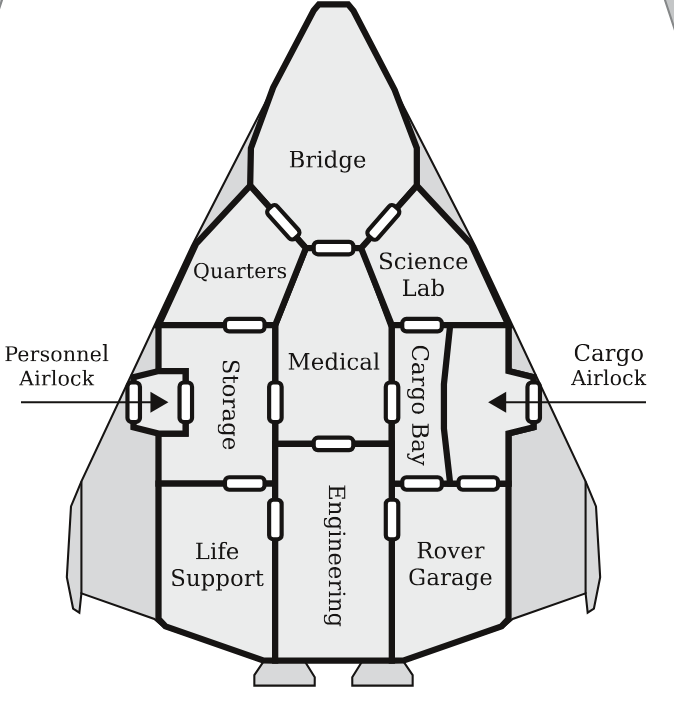 The ship has a bridge, with a wonderful view of the alien world the ship slowly orbits, crew quarters with a personal terminal featuring a procedurally generated backstory for this run, a storage section featuring a personal airlock, life support systems to keep the o2 flowing, engineering department for fixing any issues in your ships systems as your circuits are pelted with radiation, a rover garage for outfitting your surface exploring rover, the cargo bay where your rover docks and unloads, a science lab where you can research whatever samples you bring back from the alien planet, and finally a medical room with an auto-doc that can flush out some, but not all, of the radiation from your body. Each of the ships rooms is distinctly connected to either the narrative, in the case of the Capitan's Quarters, or the gameplay/survival loop of the players goal of getting out with as many samples and as little permeant radiation as possible. The gameplay loop carries out like this, The player launches the rover to the surface of the planet, the player controls the rover from the bridge and collects samples from ruins and wreckage on the alien planet, once finish the player recalls the rover back to the ship, which takes about 120 seconds. The player uses that time to use the auto-doc to remove some of their radiation and check the science lab for analyzed samples some of which may be useful machinery that can be installed into the rover. The player then uses the cargo computer to sort the cargo to either going into storage or the garage, once finished with that the rover docks and unloads it's cargo which the player will hold or send to the science lab for testing, space permitting, then send the rover either into the garage for outfitting or simply launching the rover back to the alien planet and retaking the controls in the bridge. All while resetting or repairing any systems that break down during this process from the engineering room and dealing with the difficulties of zero gravity. This loop plays out until the player has decided it's time to pack it in and go home at which point they are given an epilogue to their tale in the form of a scoresheet and high score table, something too few games, especially roguelikes, do theses day. Now, some of you might be saying, the airlocks and life support don't factor into that loop at all. But, for that you must play the game yourself, master your ship, master your rover, take multiple runs into this game, and eventually you may find yourself using the airlock and the life support systems for something other than a recreational space-walk.  I will not get into the horror elements of this game too much as they are the spoilers, the "big moments" and "end-game" of this interactive experience. I waited almost 13 hours for my first brush with the deep-space horrors, and it was all the more effective for it. What I do want to talk about is how much more effective horror is when it isn't buried in the lead up. When you feel that you are in a familiar setting, in what you assume to be favorable circumstances, where you feel you are in control. The tight gameplay loop on the ship becomes the mundane world, you get to used to it that when the horror elements start to creep up they really pack a punch and as Mike Tyson once put it "Everyone has a plan until they get punched in the face." That's true interactive horror. Not so much fumbling with the controls because they are obtuse in-and-of themselves but fumbling with the controls because you are surprised, out of your element, and panicking. That's when a game has achieved true horror. There are lots of shortcuts to get there, but except no substitutes for the real thing. When it comes to terror, canned is good, but fresh is truly better. Canned horror is a jump scare in a haunted castle advertised as a scary place to be. Fresh horror you find out in the wild but only after the environment becomes familiar to you. I love SV-4 not just for it's elegant design, it's engaging gameplay loop, it's promise of a higher score next time, and it's exceptional vibes but also because it manages to really nail everything it sets out to do with great success and it's sudden twists from tension to outright horror is one of gaming's little miracles everyone should experience for themselves at least once. This is a rare 5/5 for me with a maybe recommendation for you. If you are intrigued by the ideas this game is putting down and you'd like to give it a shot you should scoop it up on steam, sadly the dev hasn't made any other games and has stated they are unlikely to make anything else, so you really should give it a shot, it's a 15 dollar game with about as many hours of gameplay, which these days isn't the best deal in the world, but it really isn't like anything else out there, so if you want something incredibly unique in your collection you should go for it and take some time to experience it for yourself. In conclusion Scavenger SV-4 is probably my favorite niche game and a unique experience you won't get from anywhere else. It nails its atmosphere and design better than a lot of AAA space games and if you are into strange games then you should take a deep dive into this one. |
|
|